


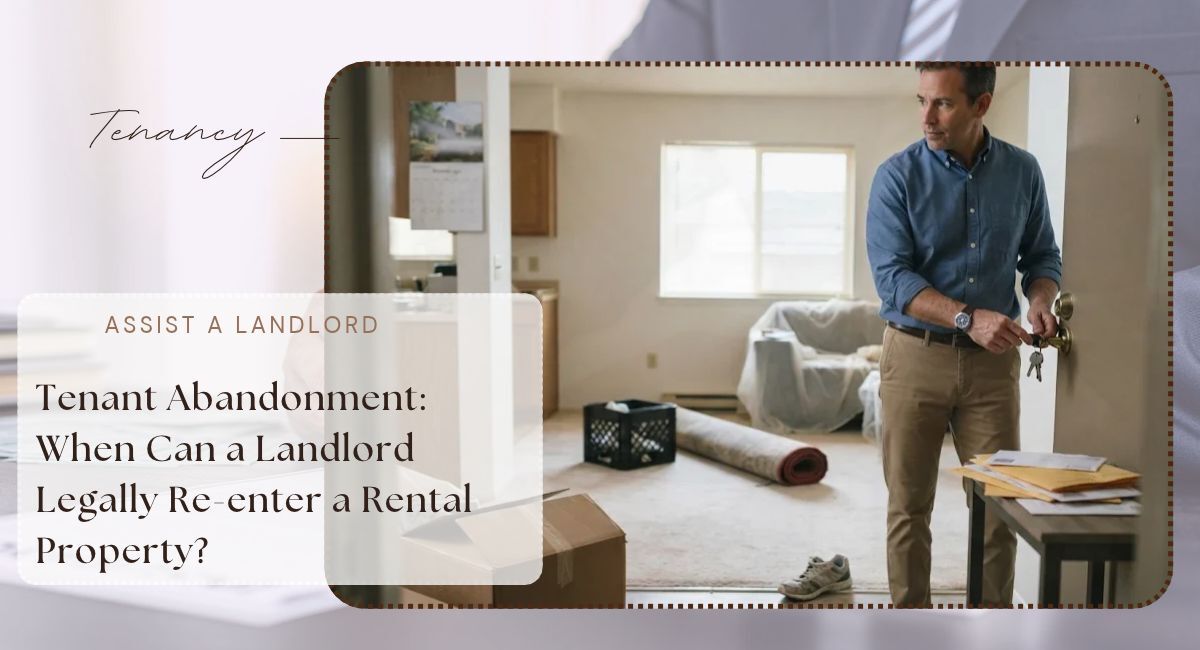
Tenant Abandonment: When Can a Landlord Legally Re-enter a Rental Property?
ou have not had a rent payment for weeks. Your calls go unanswered, the post is piling up behind the front door, and a neighbour mentions they have not seen anyone coming or going. It is easy to conclude that the tenant has abandoned your property, and just as easy to reach for your spare keys.
That instinct is understandable, but it is also where many landlords get into serious trouble. In England, a property that looks empty is not legally abandoned until the tenancy has been properly brought to an end. Until then, the tenant still has the legal right to occupy the home, and a landlord who walks in, changes the locks or clears the contents can face criminal prosecution and a civil claim for damages.
The short answer to the question in the title is this. A landlord can re-enter a property they believe has been abandoned in a genuine emergency, with at least 24 hours’ written notice for an inspection, by agreement with the tenant, or once the tenancy has ended through a valid surrender or a court possession order. Suspicion alone is not enough. This guide explains each of those routes, how the Renters’ Rights Act 2025 has changed the picture, how to build the evidence you need, and how to protect yourself while you regain control of your property. It is written with landlords across Birmingham and the wider UK in mind, but the legal position described applies throughout England.
This article provides general information and is not legal advice. If you are dealing with a live situation, take advice on your specific facts before acting.
What Tenant Abandonment Means in Law
Landlords use the word “abandonment” loosely to mean “the tenant has gone”. The law is stricter. A tenant who stops living in a property does not automatically lose their tenancy. Under English housing law, a tenant who leaves does not automatically surrender their tenancy rights, and keeps the legal right to return and resume occupation during the tenancy. That remains true even if rent is unpaid and the property looks deserted.
Many landlords assume there must be an official abandonment procedure, a notice you serve, a waiting period, and then you take the property back. Parliament did pass something along those lines in the Housing and Planning Act 2016, but those provisions were never brought into force in England, and the Renters’ Rights Act 2025 removed them from the statute book altogether. You may still come across websites describing a statutory abandonment notice for private landlords in England. There is not one, and relying on a template that claims otherwise could expose you to a charge of unlawful eviction.
There is also no fixed period after which a property is treated as abandoned. Courts look at the whole picture: rent history, contact attempts, utilities, the state of the property and anything the tenant has said. A single missed payment or a fortnight’s absence proves very little. A tenant could be in hospital, caring for a relative, working abroad for a few weeks or staying with family during a crisis. The safest working assumption is that the tenancy continues until something lawful ends it.
This matters because the consequences of getting it wrong fall on the landlord, not on the missing tenant. If you treat a property as abandoned and the tenant returns to find the locks changed, you have a problem that is far more expensive than a few extra weeks of void.
When a Landlord Can Lawfully Enter a Property
The tenant has what the law calls the right to quiet enjoyment. In practical terms, they are entitled to live in the property without interference, and the landlord’s right to enter is limited. There are four situations where entry is generally lawful, and it helps to keep them separate in your mind.
Genuine emergencies
If there is a real and immediate risk to people or property, you can enter without notice. A burst pipe sending water through the ceiling below, a suspected gas leak, smoke or signs of fire, or a flood are all examples. The purpose of the entry must be to deal with the emergency and make the property safe, not to take a look around or start gathering evidence of abandonment. If you do enter in an emergency, record why, photograph what you found, and tell the tenant in writing as soon as you can.
Entry with proper notice
For inspections, the usual route is section 11(6) of the Landlord and Tenant Act 1985. It allows a landlord with repairing obligations to enter at reasonable times of day, after giving at least 24 hours’ written notice, to view the state and condition of the property. Verbal notice is not enough. A letter delivered to the property, an email and a text message sent to the tenant’s known contact details together create a reasonable paper trail.
Many tenancy agreements also contain their own access clause, often asking for 24 hours’ notice for inspections or repairs. Check yours, but remember that a contract clause cannot give you more than the law allows. Having a spare key does not change this either.
There is a practical point that is easy to miss. If you give proper notice, the tenant does not respond and you enter at the stated time to inspect, you are acting within your rights. What you find can help you build your evidence, for instance whether the tenant’s belongings are still there. What you cannot do is treat that inspection as the moment the tenancy ends. If the property is full of furniture, clothes and food, the tenant has not given it up, whatever the neighbours say.
Welfare concerns
Sometimes the worry is not about rent at all. If a tenant has been out of contact and you have reasonable grounds to fear for their safety, for example an elderly or vulnerable tenant who has not been seen for days, call the police and ask for a welfare check rather than forcing entry yourself. If the police or emergency services need access, they have their own powers. If you do find a tenant who is ill, injured or has died, your priority is to call the emergency services, not to treat the situation as abandonment.
By agreement or after the tenancy has ended
You can also enter whenever the tenant agrees, preferably in writing, or once the tenancy has genuinely come to an end. That happens in one of two ways: the tenant validly surrenders and you accept, or you obtain a possession order and the property is recovered through the correct enforcement process. Both are covered below, because they are the real answer to most abandonment cases.
The table below pulls these situations together so you can see at a glance what each one allows and where the risk lies.
| Situation | Notice needed | What you can do | Main risk if misjudged |
| Genuine emergency (flood, fire, gas leak) | None | Enter to make the property safe | Entering for another purpose and calling it an emergency |
| Inspection or repairs | At least 24 hours’ written notice, at a reasonable time | View the condition of the property and gather evidence | Repeated or unannounced visits can amount to harassment |
| Welfare concern | None, but contact the police or emergency services | Ask for a welfare check rather than forcing entry | Forcing entry yourself on a hunch |
| Tenant agrees in writing | Agreement from the tenant | Enter for the agreed purpose | Relying on a verbal or unclear agreement |
| Valid surrender or possession order | Depends on the route | Take back and secure the property | Treating the tenancy as ended when it has not |
Why Changing the Locks Is Such a Risky Shortcut
Landlords sometimes assume that if the property is plainly empty, no one will mind. The Protection from Eviction Act 1977 takes a very different view. It makes it a criminal offence to unlawfully deprive a residential occupier of their home, or to attempt to do so, and also to harass a tenant in ways intended to make them leave. Unlawful eviction means depriving or attempting to deprive a residential occupier of occupation without going through the correct legal procedures.
On top of the criminal side, section 27 of the Housing Act 1988 gives a displaced tenant the right to claim damages through the civil courts. Those damages are assessed by reference to the difference in value of the property with and without the tenant in occupation, which can be a substantial sum, and a tenant can also claim for the loss of their belongings and the cost of alternative accommodation. A conviction in the Crown Court can carry an unlimited fine and a prison sentence of up to two years. Local authorities, including Birmingham City Council’s private rented sector enforcement teams, can and do prosecute landlords for unlawful eviction.
The offence also reaches people acting on your behalf. A managing agent, a friend with a set of keys or a contractor you instruct to “tidy up” can all be caught, and you can be held responsible for what they do on your instruction.
The risk is highest in the grey areas. Suppose a tenant who has been absent for three weeks is simply staying with a relative after an operation. You change the locks on the strength of a hunch. The tenant returns, finds themselves locked out and calls the council. At that point, it does not matter that the rent was late or that you were worried about the property. You have acted unlawfully, and a possession claim that would have been routine now sits alongside a counterclaim and a potential prosecution.
Cutting off gas, electricity or water, removing doors, or boarding up windows to encourage a tenant to leave are all forms of harassment as well. If you are tempted by any of those measures, pause and use the lawful route instead.
Building Evidence Before You Act
Whichever route you eventually take, your position will be much stronger if you can show you made proper enquiries and reached a reasonable conclusion. Evidence is what separates a landlord who acted carefully from one who acted on assumption.
Start by contacting the tenant by every channel you have: phone, text, email, WhatsApp if that is how you normally communicate, and letters addressed to the property. Also try any emergency contact, guarantor or workplace details given on the application, and consider whether any of those people can confirm the tenant’s whereabouts. Keep dated copies of everything, including call logs showing unanswered calls.
Then look for signs that point either way. Useful indicators include:
- Rent has stopped and no explanation has been offered
- Post, parcels and leaflets are accumulating
- Curtains have stayed closed and no lights have come on in the evening
- Neighbours confirm that no one has been seen for a sustained period
- Utility suppliers or the council confirm the account has been closed or a final reading requested
- Meter readings show no consumption
- A visit with proper notice shows the property cleared of personal belongings
Signs pointing the other way matter just as much. If the tenant’s furniture, clothes and food are still in the property, if they have been in touch to say they are returning, or if a family member says they are in hospital, you are not dealing with abandonment, and you should treat the tenancy as live.
If you cannot reach the tenant at all, it may help to understand the options for finding someone who has moved on without telling you. Our guide on how to locate tenants who disappear explains the practical steps and the limits of what can be done. Tracing becomes especially important if you later need to serve court papers, claim unpaid rent or deal with belongings.
Keep a simple running log of what you did and when. If this ever ends up in front of a judge, a tidy chronology of contact attempts, inspections and decisions carries real weight.
Surrender by Operation of Law and the Keys Problem
The most common way a tenancy ends in an abandonment case, other than a court order, is a surrender. A surrender is an agreement between landlord and tenant that the tenancy is over. It can be express, for example a signed document, or it can arise by what the law calls operation of law, where the conduct of both sides unmistakably shows the tenancy has ended.
The classic example is the tenant who hands the keys back with the intention of ending the tenancy, and the landlord who accepts them with the intention of taking the property back. If the tenant simply posts the keys through the landlord’s letterbox, that on its own does not amount to an implied surrender. The courts require the conduct to be unequivocal, and abandonment on its own is not enough, because the tenant must show the landlord accepted the property back.
This is a double-edged sword for landlords. You can sometimes rely on a surrender to bring a tenancy to a clean end, but you can also create one by accident. Changing the locks, redecorating for a new tenant or advertising the property and agreeing a new letting can all be read as acting on the basis that the old tenancy is finished. If it turns out the tenant never intended to give up the property, you may have taken possession unlawfully.
If a tenant returns keys while you are still deciding what to do, respond in writing straight away. State that you are holding the keys for security only, that you do not accept a surrender, and that the tenancy and the obligation to pay rent continue. If you do want to accept a surrender, put it in a short signed agreement that records the date the tenancy ends, the state of the property, how the deposit will be handled and what happens to any outstanding rent. A properly documented agreement removes most of the uncertainty and lets you re-enter and re-let quickly.
Regaining Possession Through the Courts
Where there is no clear surrender and the tenant cannot be found or will not engage, the safe route is a court possession order. This has been the position for years, but the Renters’ Rights Act 2025 has changed how the process starts.
In abandonment cases, the ground most landlords rely on is rent arrears. Ground 8 is a mandatory ground that applies where the tenant owes at least three months’ rent, or 13 weeks’ rent if paid weekly or fortnightly, both when the notice is served and at the hearing. Grounds 10 and 11, covering some unpaid rent and persistent late payment, are discretionary and also require four weeks’ notice. Because the threshold is higher than it used to be, a tenant who has stopped paying only recently may not yet qualify for Ground 8, which is another reason to act early rather than wait. Many landlords include Grounds 10 and 11 alongside Ground 8 so that other options remain open if arrears fall below the threshold before the hearing. Other grounds, such as breach of the tenancy agreement, may also be relevant if the tenant has left the property unoccupied in a way that breaches the agreement.
| Ground | What it covers | Type | Minimum notice |
| Ground 8 | At least three months’ rent arrears (13 weeks if paid weekly or fortnightly), at notice and at the hearing | Mandatory | Four weeks |
| Ground 10 | Some rent unpaid | Discretionary | Four weeks |
| Ground 11 | Persistent late payment of rent | Discretionary | Four weeks |
| Ground 12 | Breach of the tenancy agreement | Discretionary | Two weeks |
The steps are, in outline:
- Serve a valid Section 8 notice on the current prescribed form, citing the appropriate grounds, at the property and any known forwarding address.
- Wait for the notice period to expire. For rent arrears grounds, that is four weeks.
- Issue a possession claim in the county court. For landlords in the city, that will usually mean the Birmingham Civil and Family Justice Centre, although the correct court depends on the property’s address.
- Attend the hearing, or have someone attend for you, with your rent ledger, notice, proof of service and evidence of contact attempts.
- If the court grants possession, and the tenant has not left by the date specified, apply for a warrant so that county court bailiffs can enforce it.
If the tenant has already left and the property is clearly empty by the time of the hearing, the judge may still make an order, but the evidence you have gathered will make that decision far easier. In some cases, particularly where the order is for a significant sum or where speed matters, landlords may also consider transferring enforcement to the High Court. Specialist county court and High Court eviction support can help you decide which route is appropriate and avoid procedural errors that cause delay.
Procedure is where possession claims most often go wrong. An out-of-date form, an incorrectly calculated arrears figure or a notice served at the wrong address can all lead to a claim being dismissed, and the clock then starts again.
Unpaid Rent, Tracing and Recovering What You Are Owed
While the possession process runs, the tenancy continues and so does the obligation to pay rent. An absent tenant still owes rent until the tenancy ends, whether through surrender, a court order or a valid notice. That gives you a continuing claim for the arrears, and potentially for repair costs, cleaning and any other losses recoverable under the agreement.
In practice, many landlords find that getting the keys back is only half the problem. The tenant has disappeared, the deposit does not cover the arrears and damage, and there is no forwarding address. Here, early tracing and a clear record of what is owed make a real difference. A money claim in the county court, or debt recovery through a specialist provider, depends on being able to identify the debtor and serve them. If you are at that stage, debt collection support for unpaid rent can help you pursue the sums owed without tying up your own time.
Do not forget the deposit. If the tenancy ended, the deposit is held in a government-approved scheme, and any deductions must go through that scheme’s process. Withholding it informally is likely to cause a dispute, so keep your claim for arrears and damage organised and evidenced from the start.
If there were joint tenants, remember that one person leaving does not end the tenancy for the others, and each joint tenant is generally liable for the whole rent. A guarantor, if you have one, may also be liable, so check the guarantee terms as early as possible.
Dealing With Belongings Left Behind
Even when you have lawfully regained the property, you may find furniture, clothing, paperwork and rubbish left inside. It is tempting to skip it all, but the tenant’s goods still belong to them.
The Torts (Interference with Goods) Act 1977 governs what landlords can and cannot do with items left behind, and the landlord effectively becomes an involuntary bailee. That means you must take reasonable care of the goods and follow a proper process before disposing of them. Where the tenant has not authorised disposal in writing, the landlord can serve a notice under Schedule 1 giving the former tenant a reasonable period to collect, and if that is ignored, may be entitled to sell the goods.
What counts as a reasonable period depends on the circumstances, including the type and value of the goods and whether the tenant can be contacted. Photograph and list everything, store valuables securely, keep records of every attempt to reach the tenant, and deal with perishable or hazardous items sensibly. Any sale proceeds, after reasonable costs of storage and sale, should be accounted for rather than kept. For a practical walkthrough, our article on what to do if a tenant leaves belongings after eviction sets out the steps in more detail.
Do not rely on a clause in the tenancy agreement that says anything left behind is deemed abandoned. Such wording can be helpful evidence of what was agreed, but it does not remove your duty of care or your exposure to a claim if you dispose of valuable items too quickly.
A Realistic Example
Consider a landlord with a two-bedroom house in Birmingham let to a single tenant on a periodic tenancy. The tenant pays on time for a year, then misses a payment in January and another in February. Calls go unanswered. The landlord sends a letter, an email and a text, and gets no reply.
In early March, the landlord gives 48 hours’ written notice of an inspection and attends with an agent. The tenant is not home, but the property is clearly lived in: there is food in the fridge, clothes in the wardrobes and a television in the lounge. The landlord photographs the condition of the property, thanks the agent and leaves. Nothing about this visit shows abandonment, so no locks are changed.
By April, rent is three months behind. The landlord serves a Section 8 notice on Grounds 8, 10 and 11, posts it to the property and sends a copy to an address found on the original application form. Four weeks later, with no payment and no response, a possession claim is issued. At the hearing, the landlord produces the rent ledger, the contact log and the inspection photographs. The judge grants a possession order, and when the tenant does not leave by the date specified, the landlord applies for a warrant.
When the bailiffs attend, the property turns out to be empty apart from a few bin bags and a broken chair. The landlord records and photographs everything, serves a notice about the remaining items, stores anything of value for a reasonable period and then deals with the rest. The landlord then starts a separate claim for the arrears, using the tenant’s last known details and tracing support.
It takes longer than changing the locks would have done. It also leaves the landlord with a lawful possession order, a defensible paper trail and no exposure to a harassment or unlawful eviction claim.
Reducing the Chance of It Happening Again
You cannot prevent every abandonment, but you can make one easier to handle. Collect emergency contact details and a guarantor’s information at the start of each tenancy and keep them updated. Send clear written reminders when rent is late rather than letting arrears grow unnoticed. Carry out periodic inspections with proper notice so you know the condition of the property and whether the tenant is genuinely in occupation. And keep a short tenancy file for each property containing the agreement, inventory, deposit certificate and a log of communications.
Early action matters as well. Abandonment cases are rarely sudden. They usually follow a period of rising arrears, evasive responses and missed appointments. Acting at the first sign of a pattern, rather than waiting for a total breakdown, gives you more options and shortens the time between the first missed payment and the keys coming back.
Conclusion
Tenant abandonment is one of the most frustrating situations a landlord can face, partly because the law asks you to stay patient while a property sits empty and rent goes unpaid. The rules, however, are consistent. A landlord can enter without notice only in a genuine emergency, with 24 hours’ written notice for an inspection, by agreement, or once the tenancy has ended through a valid surrender or a court order. England has no statutory abandonment procedure for private landlords, and the safest way to end the tenancy where there is no clear surrender is a possession claim under Section 8.
The steps in between are what protect you: contact the tenant by every available route, document what you find, avoid actions that could be read as accepting a surrender unless you intend that, treat belongings carefully, and pursue the arrears separately once possession is secure. The extra time spent following the process is almost always cheaper than defending an unlawful eviction claim.
If you are dealing with a tenant who has stopped paying rent or appears to have abandoned the property, you do not have to handle the situation alone. Tenant eviction lawyers UK can help landlords understand their legal options and take the appropriate steps to recover possession lawfully and efficiently. Whether you need assistance with serving a Section 8 notice, preparing for court proceedings or recovering outstanding rent, seek professional eviction support today to get clear, practical guidance at every stage of the process.
Sorry, the comment form is closed at this time.